
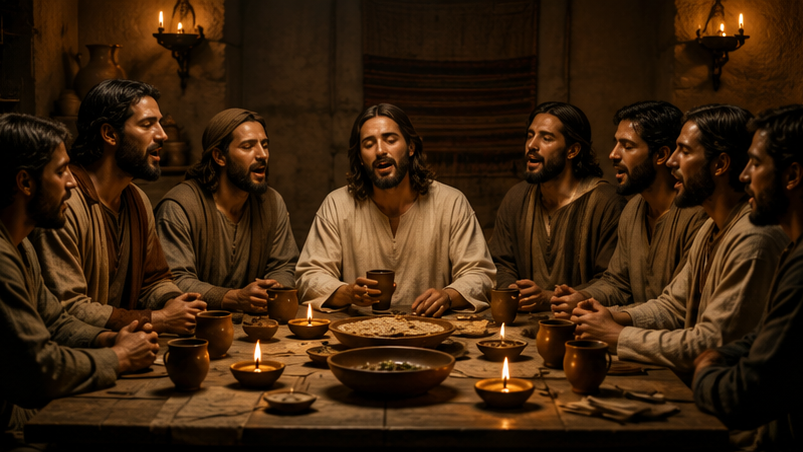
There is a tiny detail in the story of Jesus’ final night that is easy to read past.
The bread had been broken. The cup had been shared. Betrayal was already moving through the darkness. Gethsemane was waiting. Arrest, humiliation and the cross were drawing frighteningly close.
And then Jesus sang.
Matthew records simply that, “after singing a hymn, they went out to the Mount of Olives.” Mark preserves the same remarkable detail.
It occupies only a few words in the Gospel.
Yet think about what those words mean.
Jesus knew where He was going.
He knew that Judas would betray Him. He knew His disciples would scatter. He knew suffering was approaching. Within a short time, in Gethsemane, Mark describes Jesus as deeply troubled and sorrowful.
But between the table and the garden, there was a song.
That raises a fascinating question:
And perhaps an even more intriguing one:
Yes, Jesus Really Sang
Christians often picture Jesus teaching, praying, healing, walking, eating with people, weeping and preaching.
We do not often picture Him singing.
Yet the Gospels leave little room for doubt on this particular point. Matthew 26:30 and Mark 14:26 both tell us that Jesus and His disciples sang before leaving for the Mount of Olives.
We do not know what Jesus’ singing voice sounded like.
We do not know whether He sang loudly or softly.
We do not know the melody.
The Gospel writers do not tell us any of those things.
But they tell us enough to create one extraordinary image:
That detail matters.
Filename: `jesus-singing-last-supper-featured.webp` Alt: Jesus and His disciples singing a hymn after the Last Supper before going to the Mount of Olives.
What Hymn Did Jesus Sing at the Last Supper?
This is where we need to separate what the Bible explicitly says from what historical tradition makes likely.
The Gospels tell us that they sang a hymn.
They do not give us its title.
Because the meal took place in the context of Passover, many interpreters have connected the hymn with the collection of Psalms traditionally known as the Hallel, especially Psalms 113–118.
These Psalms became closely associated with Jewish festival worship and Passover. Later Jewish Passover practice places part of the Hallel before the meal and part after it. Bible reference works have therefore commonly suggested that the hymn mentioned in Matthew and Mark may have included the concluding Hallel Psalms.
But there is an important qualification.
Scholars caution that we cannot simply take the exact structure of later Jewish Passover practice and prove that every detail functioned identically in Jesus’ time. The connection with the Hallel is plausible and traditional, but Scripture itself does not identify a particular Psalm.
That distinction actually makes the story more interesting, not less.
We can say confidently:
We can say reasonably:
What we should not say is:
“The Bible tells us Jesus definitely sang Psalm 118.”
It does not.
That is an important difference between discovering something beautiful in Scripture and putting words into Scripture that are not there.
What Were the Hallel Psalms?
The Hallel is a collection of praise Psalms traditionally associated with Psalms 113 through 118.
The word is related to praise—the same family of language behind _hallelujah_.
These are not shallow “everything is wonderful” songs.
They remember deliverance.
They speak about trust.
They remember oppression and rescue.
They call people to praise when circumstances give them reasons both to rejoice and to tremble.
Psalm 114 looks back toward Israel’s Exodus from Egypt.
Psalm 116 speaks from the perspective of someone who has encountered terrible distress and calls upon God.
Psalm 118 celebrates God's enduring goodness, deliverance and victory, while also containing imagery later used prominently in Christian interpretation of Jesus.
The Hallel therefore brings together memory, suffering, rescue, thanksgiving and praise. Its connection with Passover is deeply fitting because Passover itself remembers liberation.
Imagine the contrast.
Jesus is remembering God's rescue of Israel while preparing to enter His own suffering.
A song about deliverance stands immediately before Gethsemane.
Filename: `passover-hallel-last-supper-setting.webp` Alt: A historically inspired Passover table illustrating the setting in which Jesus and His disciples sang after the Last Supper.
The Song Came Before Gethsemane
The placement of the hymn may be the most emotionally powerful part of the story.
Mark moves almost immediately from the singing to the Mount of Olives and then Gethsemane.
There Jesus becomes deeply distressed.
He tells Peter, James and John that His soul is overwhelmed with sorrow. He prays about the suffering before Him, yet submits Himself to the Father's will.
This means the Gospel does not present Jesus singing because He was unaware of suffering.
Quite the opposite.
The song stands beside the suffering.
That gives Christian worship an entirely different meaning.
We often imagine that singing belongs to moments when everything is going well.
We sing after the victory.
After the answer.
After the healing.
After the problem has disappeared.
But Jesus sang before the garden.
Before the arrest.
Before Peter's denial.
Before the trial.
Before the cross.
His worship was not a denial of reality.
It existed in full view of reality.
Worship Is Not Pretending That Nothing Hurts
There is a version of faith that tells people they should smile when they are breaking inside.
That is not what happens here.
Jesus does not sing and then stroll casually through Gethsemane as though nothing bothers Him.
He sings—and later expresses profound sorrow.
He worships—and He agonizes.
He trusts—and He still asks whether the cup can pass from Him.
The two experiences exist beside each other.
That is important for anyone who has ever felt guilty because faith did not remove their pain.
You can trust God and still grieve.
You can pray and still feel afraid.
You can sing and still need to cry afterward.
You can believe God is good without pretending the thing happening to you is good.
Jesus’ final night does not give us a picture of emotional numbness.
It gives us a picture of faithfulness in the middle of real emotion.
That is very different.
Filename: `music-scripture-difficult-night.webp` Alt: A person turning to Scripture and music during a difficult night.
Perhaps Some Truths Need to Be Sung
The Bible contains an extraordinary amount of music.
Moses sings.
Miriam sings.
David writes songs.
The Psalms give generations words for praise, anger, fear, repentance, gratitude, grief and hope.
Mary responds to God's work with a song of praise.
Paul and Silas sing while imprisoned.
And Jesus sings before going to the Mount of Olives.
Why?
Perhaps because human beings do something with truth when we sing it that is different from simply reading it.
A song can carry memory.
A melody can bring words back years later.
Music can bind people together.
It can give a group one voice when individual hearts are experiencing different emotions.
Modern research continues to investigate the relationship between music, emotion, memory, stress and social connection. Results vary depending on the context, individual and type of musical activity, so music should never be presented as a magical cure. But contemporary research does support something humans have intuitively understood for a very long time: music can participate powerfully in the way people experience and regulate emotion.
Scripture did not need a neuroscience laboratory to recognize that songs travel with people through life.
Some truths are spoken.
Some are prayed.
And some are remembered because somebody taught us to sing them.
What If Jesus Sang Psalm 118?
Again, we must say if.
The Gospel does not identify the hymn.
However, Psalm 118 belongs to the Hallel tradition and is frequently proposed as part of what may have been sung at the conclusion of the Passover meal.
That possibility has fascinated Christians for centuries because Psalm 118 contains themes that become striking when read beside the Passion.
It speaks of distress and deliverance.
It speaks of trusting God rather than human strength.
It celebrates God's enduring mercy.
It contains the image of the rejected stone becoming foundational—language later applied to Jesus in the New Testament.
And it repeatedly moves from danger toward praise.
If those words were among the words Jesus sang that night, the scene becomes extraordinary.
But even if we cannot identify the exact hymn, the Gospel’s central point remains untouched:
That is the fact we know.
Jesus Did Not Wait for the Situation to Improve
This might be the lesson that reaches furthest beyond the Upper Room.
Many of us postpone peace.
We tell ourselves:
_I will breathe when this problem is solved._
_I will worship when the answer comes._
_I will be grateful when life becomes easier._
_I will trust when I understand what God is doing._
But life rarely gives us such clean endings.
One difficulty disappears and another appears.
One prayer is answered while another remains unresolved.
Jesus’ song challenges the assumption that worship requires ideal circumstances.
He did not wait for Good Friday to pass.
He did not wait for Easter morning.
He sang on Thursday night.
There is something profoundly human about that.
Faith is not only celebrating the resurrection after you know the tomb is empty.
Sometimes faith is singing while Gethsemane is still ahead of you.
Filename: `people-singing-through-difficult-season.webp` Alt: People singing together during a reflective time of prayer.
Singing Also Meant Jesus Did Not Face the Night Alone
There is another detail worth noticing.
Matthew does not say that Jesus sang a private solo.
Jesus and His disciples shared the hymn together.
Soon, those disciples would fail Him in painful ways.
One had already betrayed Him.
Peter would deny Him.
Others would flee.
Yet at the table they still shared a song.
There is something beautiful here about communal worship.
We do not always know what the person beside us is carrying.
Someone may be singing after receiving wonderful news.
Another may be singing while waiting for medical results.
Someone may be grieving.
Someone may feel close to God.
Someone may barely be holding onto faith.
Yet for a few minutes, different lives share the same words.
Perhaps that is one reason communal singing has survived across centuries of Christian worship.
Sometimes another person's voice carries the song when yours is weak.
What This Means When You Are Facing Your Own Gethsemane
Most of us will never experience anything resembling the Passion of Christ.
But everyone eventually experiences a night they did not choose.
A diagnosis.
A broken relationship.
A frightening phone call.
Grief.
Financial pressure.
Failure.
Loneliness.
Uncertainty about a child.
A future that suddenly looks very different from the future you imagined.
The hymn after the Last Supper does not promise that singing removes those experiences.
Jesus sang and still went to Gethsemane.
What it shows us is something subtler:
There may still be room for prayer.
There may still be room for companionship.
There may still be room for memory.
There may still be room for gratitude.
There may even still be room for a song.
Not because the darkness is imaginary.
But because darkness is not the only reality present.
A Different Way to Think About Strength
Our culture often imagines strength as appearing unaffected.
Do not cry.
Do not shake.
Do not admit fear.
Keep moving.
Jesus gives us something better.
In the same night, He can sing and sorrow.
He can walk forward and ask His closest friends to remain near Him.
He can express anguish and still surrender Himself to the Father.
Christian strength is therefore not emotional invulnerability.
It is faithfulness.
Sometimes courage looks like a victory shout.
Sometimes it looks like kneeling in a garden.
And sometimes it sounds like a hymn sung before you take the next difficult step.
Filename: `olive-grove-dawn-hope.webp` Alt: Sunrise over an olive grove symbolizing hope beyond the darkness of Gethsemane.
The Detail We Should Not Read Past
It would have been easy for Matthew and Mark to move directly from the Last Supper to the Mount of Olives.
But both preserve the song.
Two thousand years later, those few words still stop us.
Jesus sang.
He sang with people who did not yet understand everything that was happening.
He sang before a night of suffering.
He sang before His prayers in Gethsemane.
And whether the hymn included Psalm 118 or another part of the Passover tradition, He walked from worship toward what He knew He had to face.
Maybe that is why this tiny detail matters so much.
It reminds us that worship is not merely the soundtrack of happy lives.
Sometimes it is the sound of trust before the answer arrives.
Sometimes it is what we carry into the darkness.
And sometimes the bravest song is the one sung before morning comes.
Questions People Often Ask
Did Jesus actually sing in the Bible?
Yes. Matthew 26:30 and Mark 14:26 both state that Jesus and His disciples sang a hymn after the meal before going to the Mount of Olives.
What song did Jesus sing before His Crucifixion?
The Bible does not identify the exact hymn. Because the setting was Passover, many interpreters connect it with the Hallel Psalms associated with Passover, traditionally Psalms 113–118. However, we should treat the identification of a specific Psalm as historical probability rather than an explicit statement of Scripture.
Did Jesus sing Psalm 118?
Possibly, but we cannot say with certainty. Psalm 118 belongs to the Hallel collection associated with Passover, and many Christian interpreters have suggested that it could have formed part of the hymn sung after the meal. The Gospel text itself simply says that they sang a hymn.
Why is Jesus singing before Gethsemane important?
The sequence shows that worship and sorrow are not opposites. Jesus sang before entering a scene in which the Gospels describe Him as deeply distressed. His example suggests that faith does not require pretending that suffering is painless.
What can Christians learn from this?
Among other things, the story shows that worship does not have to wait until circumstances improve. Prayer, singing, community and trust can exist alongside fear, grief and uncertainty.
A Question for You
Share this article with someone who may need that reminder today.
And the next time a song gives you words when your own words have disappeared, remember:
Sources
Continue With Music
Let the reading turn into worship. Listen, sing along, or open the Scriptures behind this article.
Read the Scripture
Keep Reading

The Bible Says God Sings Over You — What Does Zephaniah 3:17 Really Mean?
Many people imagine God listening to our songs. Zephaniah gives us a far more surprising picture: God Himself rejoicing over His restored people with song. But the verse means even more when you discover what comes before it.

What the Bible Says About Music, Singing & Worship
A comprehensive look at music in Scripture — from King David's psalms to New Testament hymns.